An electric motor is a machine that converts electrical energy into mechanical energy, almost always delivered as a rotating shaft. Electricity goes in; the shaft turns; the shaft runs a machine such as a pump, fan, compressor, conveyor, or gearbox. Everything else in this manual is detail hung on that one sentence.
ANALOGY An electric motor is to a factory what a muscle is to your body. Food (electricity) supplies the energy, but it is the muscle (the motor) that actually moves the bone (the shaft) so useful work gets done. Nobody eats for the sake of eating; nobody buys a motor for the sake of the motor. They buy the movement it produces. |
So the first professional habit is this: never think only “motor.” Think about the whole system the motor lives in.
REMEMBER The professional seller's mental model: motor + load + power supply + mounting + environment + control method. Miss any one of these and the quotation is incomplete. |
1.1 The shaft does the work
Customers rarely buy a motor because they love motors. They buy it because they need to rotate something — an impeller, a fan wheel, a gearbox input, a conveyor pulley. The shaft is where the motor meets the real world, so the shaft is where selling really begins.
This is why a bare power figure is never enough. When a customer says “I need a 15 kW motor,” the professional brain immediately answers with a question: “For what application?” A 15 kW motor for a ventilation fan and a 15 kW motor for a rock crusher may not be the same machine at all, even though both say 15 kW.
WATCH OUT “Same kW” does not mean “same motor.” Two motors can share a power rating yet differ in speed, torque behaviour, frame size, mounting, and enclosure. Power is the starting point of a selection, never the end of it. |
1.2 The words you must own first
Power — kW or HP
Power tells us the size or capacity of the motor: how much mechanical work it can deliver continuously. In most of the world it is stated in kilowatts (kW); in North America it is often horsepower (HP).
WORKED EXAMPLE Quick conversions: 1 HP ≈ 0.746 kW and 1 kW ≈ 1.34 HP. So 4 kW ≈ 5.4 HP. If a customer asks for 4 kW, do not reflexively quote “5 HP” — depending on the standard and the market, suppliers may offer the nearest standard size, which could be 5.5 HP or a 4 kW IEC frame. Confirm before committing. |
Speed — RPM
RPM (revolutions per minute) tells you how fast the shaft turns. For a mains-fed AC induction motor, speed is set mainly by the number of magnetic poles and the supply frequency. The common no-load synchronous speeds are worth memorising:
At 50 Hz: 2-pole ≈ 3000 rpm, 4-pole ≈ 1500 rpm, 6-pole ≈ 1000 rpm, 8-pole ≈ 750 rpm (running speeds are slightly lower, e.g. 2900 / 1470 / 980).
At 60 Hz: 2-pole ≈ 3600 rpm, 4-pole ≈ 1800 rpm, 6-pole ≈ 1200 rpm, 8-pole ≈ 900 rpm.
WATCH OUT A 15 kW 2-pole motor and a 15 kW 4-pole motor are NOT the same motor. They share power but spin at very different speeds and produce very different torque. For pumps and fans especially, the wrong speed ruins machine performance. |
Torque — the turning force
Torque is the twisting effort the shaft delivers — the force that actually turns the load. Power, speed, and torque are linked: for a given power, lower speed means higher torque, and higher speed means lower torque.
ANALOGY Think of cycling. Power is how hard you can work overall. In a high gear (high speed) the pedals spin fast but feel light — low torque. Drop to a low gear to climb a hill and the pedals turn slowly but with huge force — high torque. A crusher is a steep hill: it needs torque, not just power. |
SALES TIP Power alone cannot tell you whether a motor will start its load. A motor can have exactly the right kW and still stall if its starting torque is below what the machine demands. Always ask what the motor is driving. |
1.3 AC versus DC
An AC motor runs on alternating current and dominates industry. The reason is elegant: three-phase AC naturally creates a rotating magnetic field inside the stationary part of the motor, and that rotating field drags the rotor and shaft around with it — no brushes or commutator required. The overwhelming majority of low-voltage industrial motors you will sell are three-phase AC induction motors, used on pumps, fans, compressors, and conveyors.
A DC motor runs on direct current. You will still meet DC motors in older equipment, battery systems, cranes, traction, and certain precise speed-control jobs, but for ordinary industrial replacement work, AC induction motors are far more common.
1.4 Single-phase versus three-phase
Single-phase motors are usually smaller and appear where only single-phase supply exists — small domestic and light-commercial pumps, fans, and appliances. Three-phase motors are the backbone of industry: pumps, fans, compressors, conveyors, and general machinery. Inside, the stator is the stationary part and the rotor is the rotating part; the stator's field is what pulls the rotor (and the shaft) round.
REMEMBER Your core focus, and the starting point for almost every quotation, is the low-voltage three-phase squirrel-cage induction motor. Master it first; everything else is a variation on it. |
1.5 Voltage and frequency must match the site
Every motor's power supply has two non-negotiable items: voltage (for example 230 V, 400 V, 415 V, 460 V, 690 V, or medium-voltage levels such as 3.3 kV, 6.6 kV, 11 kV) and frequency (50 Hz or 60 Hz). These must match the customer's site, because they change the motor's speed, current, and sometimes its power.
WATCH OUT Never wave away voltage and frequency. A motor designed for 400 V / 50 Hz is not automatically suitable for a 460 V / 60 Hz site. Only the nameplate or datasheet can confirm dual ratings — do not assume them. |
1.6 The load is part of the selection
The load is the machine bolted to the motor shaft, and it is one of the most important ideas in this manual. Different loads demand different starting torque, different duty, and sometimes different motor types. A centrifugal pump starts easily; a loaded conveyor or a crusher does not.
WORKED EXAMPLE Two genuine 15 kW requests. One drives a ventilation fan (an easy, low-starting-torque load — a standard motor is fine). The other drives a loaded screw conveyor that must break away from standstill under full load (high starting torque — the standard motor may stall). Same kW, different motor. |
1.7 The first professional motor sentence
A complete motor description reads like a single, dense sentence. You do not need to master every term today, but you must learn to recognise the shape of it:
REMEMBER “15 kW, 4-pole, 400 V, 50 Hz, 3-phase, B3 foot-mounted, IP55, TEFC, Class F, S1 duty induction motor.” Power, speed, supply, mounting, protection, cooling, insulation, duty, type — every chapter ahead simply unpacks one of these words. |
1.8 The architecture: how the parts fit together
Before studying individual components in Chapter 3, hold the whole machine in your head. An induction motor is built around two electromagnetic parts — the stationary stator and the rotating rotor — wrapped in a frame that protects them, supported by bearings, cooled by a fan, and connected to the outside world through a terminal box. The major motor makers (for example WEG and ABB) describe the same basic structure.
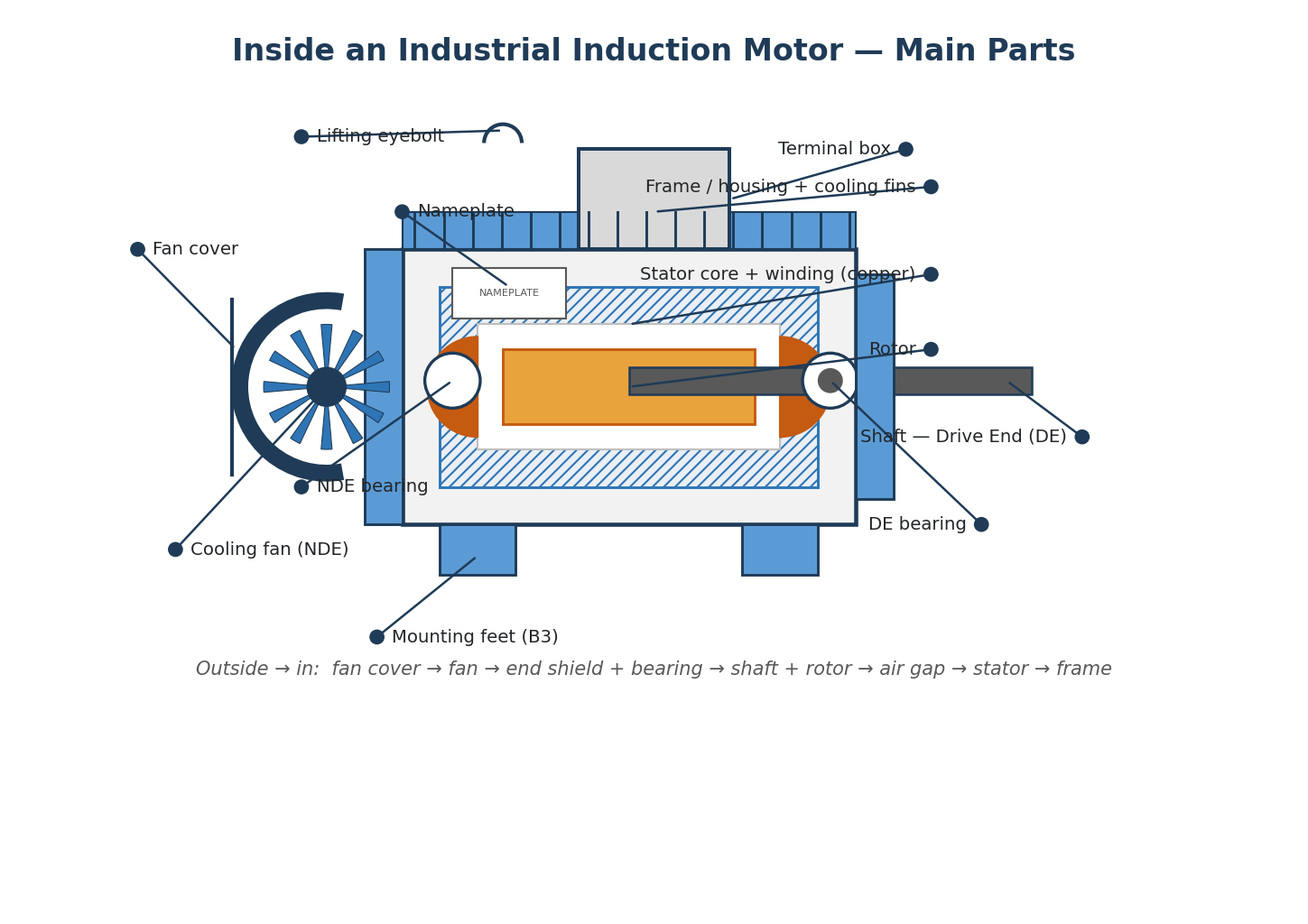
Figure 1.1 — The main parts of an industrial induction motor and how they nest together.
Trace the energy path once and the architecture becomes obvious:
REMEMBER Electricity enters the terminal box → the stator winding creates a rotating magnetic field → the rotor follows it and turns → the shaft delivers mechanical power to the load → the bearings support the shaft → the fan removes the heat → the frame holds and protects everything. |
From the outside working inward, the order is: fan cover, cooling fan, end shield plus bearing, shaft and rotor, the air gap, the stator winding and core, and finally the frame — with the terminal box and nameplate mounted on the outside where you can reach them.
Knowledge Check — Chapter 1
An electric motor converts electrical energy into what?
What does RPM mean, and what mainly sets it on a mains-fed induction motor?
Which is more common for industrial pumps: single-phase or three-phase?
Why is “15 kW motor” not enough information to quote?
A customer needs a motor for a crusher. Should you care about torque, and why?
What are the two supply details you must always check against the site?