This is the chapter that separates a salesperson from a sales engineer. Customers almost never say “I need a squirrel-cage induction motor.” They say “I need a motor for my compressor,” or “I need a replacement for this pump motor.” Your job is to translate the application into the right type of motor.
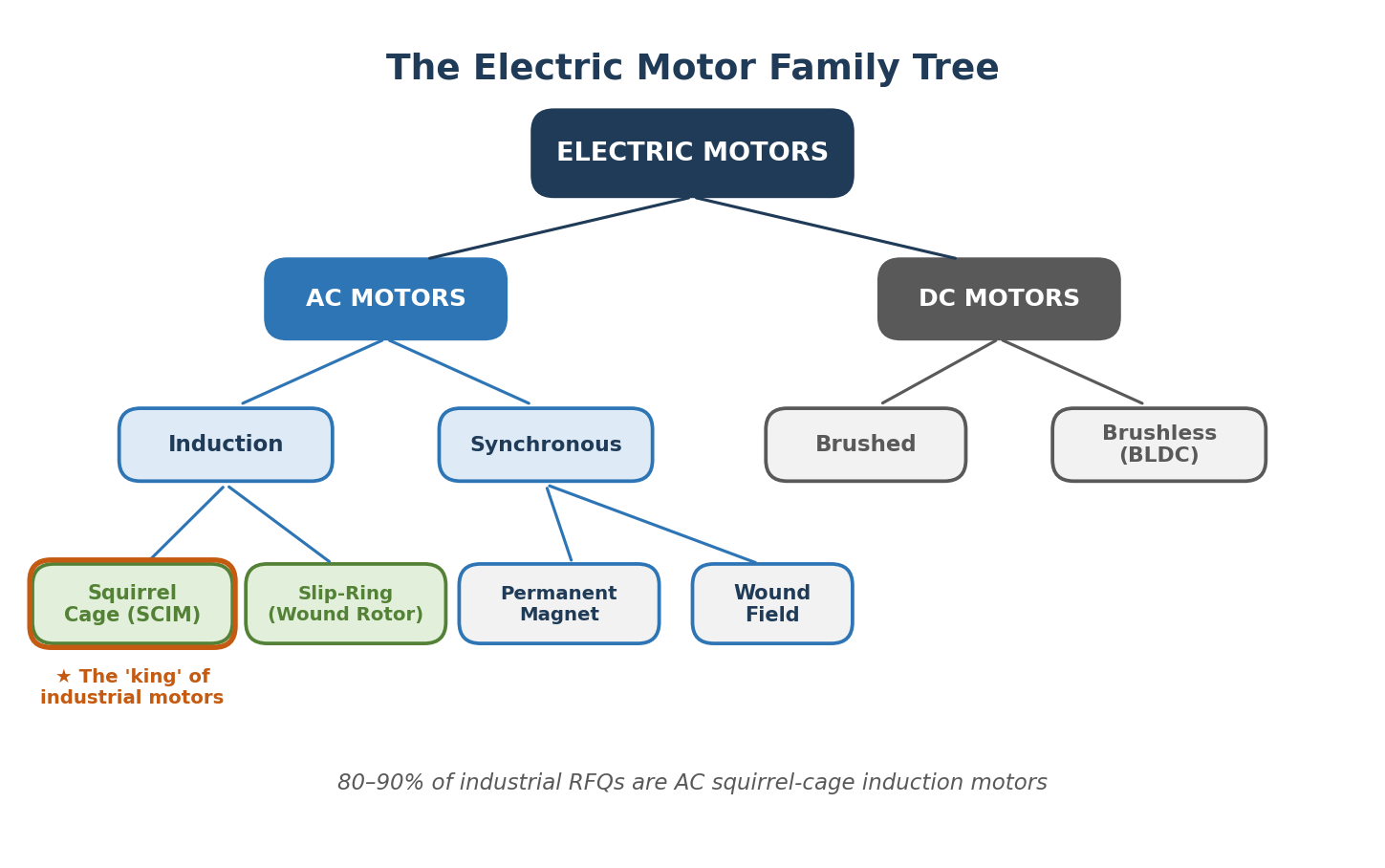
Figure 2.1 — The electric-motor family tree. As an industrial seller, 80–90% of your RFQs live in the squirrel-cage induction branch.
ANALOGY Think of motor types like vehicles. A squirrel-cage induction motor is the everyday car — reliable, cheap, everywhere. A slip-ring motor is the tractor — slow and expensive but unstoppable under heavy load. A synchronous motor is the cruise-control highway car — rock-steady speed. A servo is the drone — tiny, precise, instantly responsive. You match the vehicle to the journey, not the other way round. |
2.1 Squirrel-Cage Induction Motor (SCIM) — the king
This is the motor you will sell most. It is a three-phase AC machine of beautifully simple construction: a wound stator and a rugged rotor made of conductor bars short-circuited at each end — the “squirrel cage.” There are no brushes and no slip rings, so there is very little to wear out.
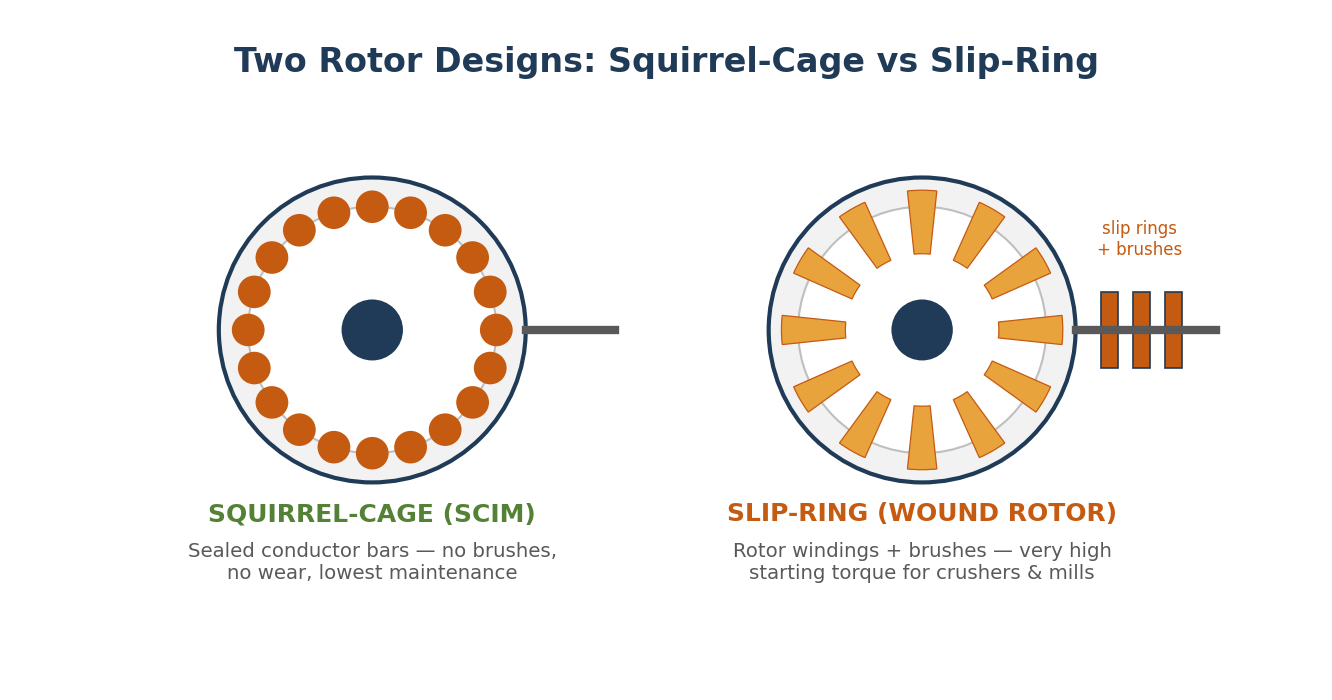
Figure 2.2 — Squirrel-cage rotor (left) versus wound/slip-ring rotor (right).
Typical applications: pumps, fans, compressors, conveyors, HVAC, mixers, blowers, and general industrial machinery. Strengths: lowest maintenance, lowest cost, widely available, high reliability. Limitations: essentially fixed speed unless paired with a VFD, and lower starting torque than some special types.
SALES TIP When an RFQ reads simply “30 kW, 400 V, 50 Hz, TEFC, B3,” there is a very high probability the customer wants a standard squirrel-cage induction motor. Quote it as the baseline, then confirm the application. |
2.2 Slip-Ring Motor (Wound-Rotor Motor)
Instead of a cage, this rotor carries real windings whose ends are brought out through slip rings and carbon brushes. By adding external resistance to the rotor circuit during start, it delivers very high starting torque while drawing lower starting current — ideal for heavy, hard-to-start loads.
Applications: crushers, mills, hoists, cranes, mine conveyors, cement kilns. Trade-offs: brushes wear and need maintenance, and the motor costs more than a cage machine.
WATCH OUT If a customer mentions a large crusher or a ball mill, do not reflexively assume a squirrel-cage motor. Check whether a slip-ring motor — or a specially designed high-starting-torque cage motor with the correct starting method — is required. |
2.3 Synchronous Motor
Unlike an induction motor, the rotor here turns at exactly synchronous speed with no slip. These machines run at constant speed, are very efficient, and can even be used to improve a plant's power factor. They tend to be large. Applications: steel plants, refineries, large compressors and pumps, paper mills. Trade-offs: higher cost and more complex control.
2.4 Permanent-Magnet Motor (PM)
PM motors replace rotor-induced current with permanent magnets, giving very high efficiency, compact size, and high torque density. Applications: high-efficiency pumping, compressors, electric vehicles, robotics, and modern industrial drives. They almost always run with a VFD.
2.5 DC and Brushless DC (BLDC)
A brushed DC motor offers excellent speed control but needs brush maintenance; it survives in rolling mills, cranes, battery equipment, and traction. A brushless DC motor (BLDC) is the modern descendant — no brushes, high efficiency, long life, compact — used in medical equipment, drones, EVs, and automation. BLDC is rarely quoted in general industrial pump RFQs.
2.6 Servo Motor
Servo motors deliver very accurate position, speed, and torque control, and are supplied with an encoder and a matched servo drive. Applications: CNC machines, packaging machinery, robotics, pick-and-place systems.
2.7 Brake Motor and Gear Motor
A brake motor is a standard motor fitted with an electromagnetic brake that stops it the instant power is removed — essential for cranes, hoists, elevators, conveyors, and vertical applications. A gear motor combines a motor with a gearbox to trade speed for torque, common on conveyors, mixers, packaging, and food machinery.
2.8 Special-Duty Motors
Explosion-proof / flameproof motors for hazardous areas (oil & gas, refineries, LNG, chemical plants), typically certified to ATEX, IECEx, or North American Class I schemes — covered fully in Chapter 8.
Marine motors with C5 corrosion protection, space heaters, special bearings, and class-society approval (DNV, ABS, Lloyd's Register, Bureau Veritas) for ships, offshore platforms, and ports.
High-voltage motors at 3.3 kV, 4.16 kV, 6.6 kV, or 11 kV for large pumps, compressors, fans, mining, and steel plants. These are engineered products that require a datasheet, a GA drawing, type testing, and customer approval.
Inverter-duty motors, designed and insulated specifically to survive continuous VFD operation (see Chapter 7).
2.9 The application-to-type decision flow
When an RFQ arrives, walk it through five questions in order:
What machine? Pump, fan, compressor, conveyor, crusher, mixer — the load type frames everything.
What environment? Indoor, outdoor, dusty, washdown, hazardous, marine, high-temperature?
Variable speed needed? If yes, think VFD with an inverter-duty or PM motor.
Very high starting torque needed? If yes, consider a slip-ring motor or a heavy-duty cage motor with the right starter.
Precise positioning needed? If yes, it is a servo motor.
WORKED EXAMPLE Quick reads: “75 kW pump, 400 V, 50 Hz” → standard TEFC squirrel-cage. “500 kW cement crusher” → check for slip-ring or special high-torque design; do not assume standard. “Robot arm” → servo motor. “Offshore platform” → marine and/or hazardous-area motor per the area classification. |
SALES TIP When a customer says “just replace this motor,” resist thinking only about power. Ask: what type is it, what does it serve, is it standard or special, does it need hazardous-area approval, is it VFD-driven, does it need high starting torque, and do project specs restrict acceptable brands or certifications? |
Knowledge Check — Chapter 2
What is the most common industrial motor for pumps and fans?
Why might a customer need a slip-ring motor instead of a standard SCIM?
Which motor type suits robotics and CNC machines?
What is the main purpose of a gear motor?
Which motor type most likely needs ATEX, IECEx, or a North American hazardous-area certificate?
For a 500 kW ball mill, would you automatically quote a standard squirrel-cage motor? Explain.