The nameplate is the small metal label on the motor body, and for a seller it is the single most important source of information for replacement, quotation, spares, and supplier RFQs. Both WEG and ABB treat the rating plate as the key reference for installation, operation, and identification. A motor nameplate carries the electrical rating, speed, frame, protection, insulation, duty, efficiency, current, ambient, altitude, bearing data, and connection diagram.
REMEMBER Your golden rule: no nameplate = high quotation risk. If a customer wants a replacement, the first thing you ask for is a clear photo of the nameplate showing the model and serial number. |
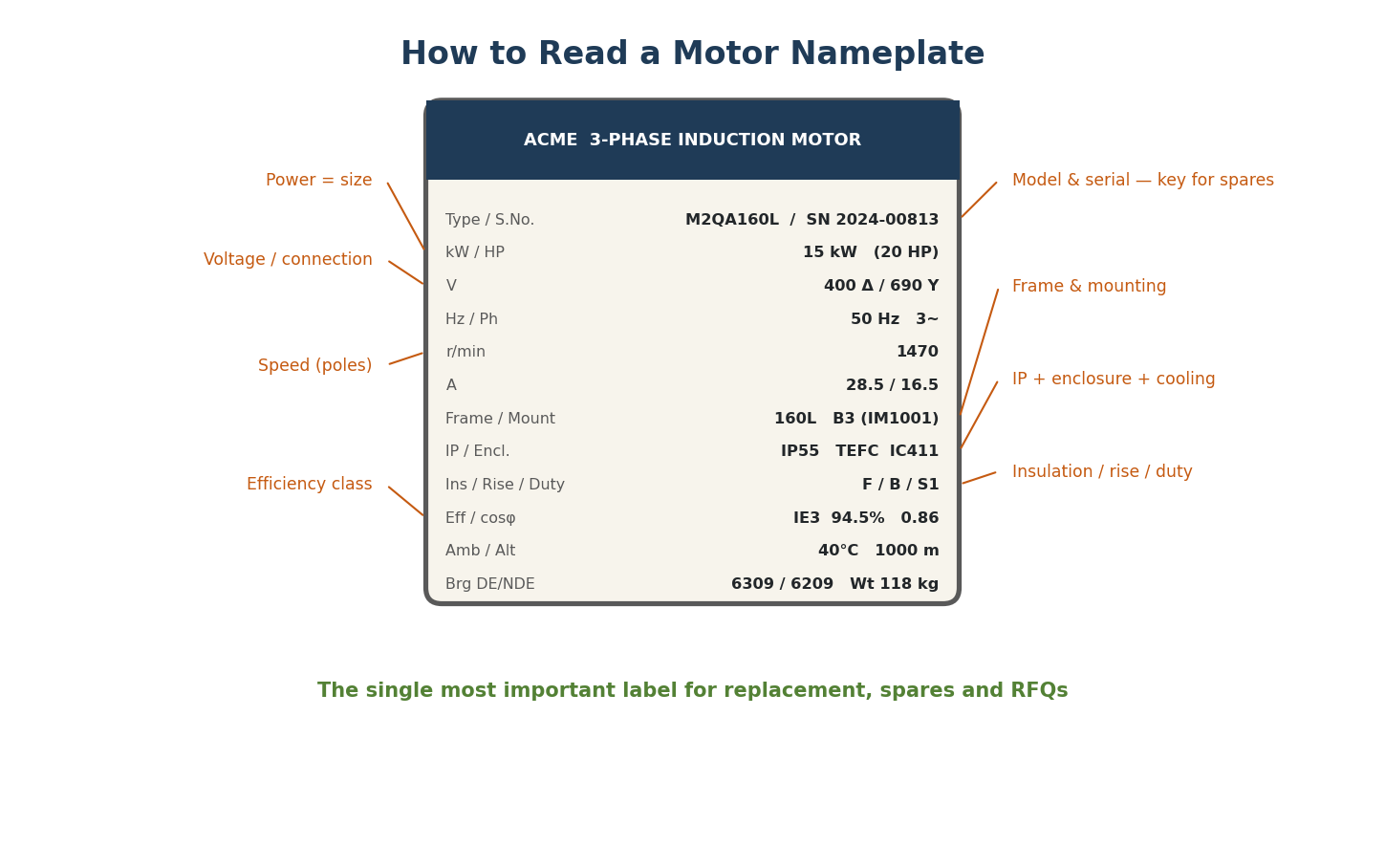
Figure 9.1 — A worked nameplate with the fields that matter most to a seller.
9.1 Read it in four groups
Don't be overwhelmed by a crowded plate. Read it in four passes: (1) identity — maker, type, serial number; (2) electrical — power, voltage, frequency, phase, current; (3) mechanical/protection — frame, mounting, IP, enclosure, cooling; (4) performance/thermal — speed, insulation, rise, duty, efficiency, ambient, altitude, service factor.
9.2 Identity: maker, type, serial number
The serial number is gold for spare parts: with it, the manufacturer can usually identify the exact bearings, fan, fan cover, terminal box, original drawing, and full configuration. Always capture model and serial number, ideally from a clear photo.
9.3 The electrical block
Phase: 1~ / 1 PH or 3~ / 3 PH. Industrial motors are overwhelmingly three-phase.
Power: kW or HP (1 HP ≈ 0.746 kW). Power alone never identifies a motor — a 15 kW 2-pole and a 15 kW 4-pole are not interchangeable.
Voltage: e.g. 400 V, or dual like 400/690. Dual voltages relate to the connection (often 400 Δ / 690 Y) — confirm via the connection diagram. Do not quote a 400 V/50 Hz motor for a 460 V/60 Hz site unless the plate/datasheet says so.
Frequency: 50 Hz or 60 Hz, or both (with different power/speed/current at each).
Current: full-load amps (e.g. A: 28.5). If voltage has two values, current usually has two (e.g. 28.5/16.5). Current drives cable, overload relay, contactor, soft starter, and VFD sizing.
9.4 Speed, frame, mounting
Speed appears as RPM, r/min, or min⁻¹ (e.g. 1470 means about 1470 rpm at rated load — a 4-pole 50 Hz machine). For pumps and fans, speed is critical: 2900 rpm where 1450 was expected wrecks performance. Frame (e.g. 160L) is a mechanical identity that fixes shaft height, shaft diameter, foot spacing, and body size (Chapter 4). Mounting (B3, B5, B35, V1, C-face…) may be on the plate or only on the datasheet/drawing — wrong mounting means the motor cannot be installed.
9.5 Protection, insulation, duty, efficiency
These fields are explained in depth in Chapters 5 and 6; on the plate they appear briefly:
IP rating (e.g. IP55): dust + water protection (IEC 60529).
Enclosure / cooling (TEFC, ODP, TENV; IC411…): how the motor is protected and cooled.
Insulation class (Ins. Cl. F / H, per IEC 60085) and temperature rise (e.g. ΔT 80K). 'Class F insulation, Class B rise' signals extra thermal margin.
Duty (S1, S2, S3…): how the motor is intended to run; S1 = continuous.
Efficiency (IE2/IE3/IE4 or NEMA Premium, e.g. 'IE3 – 94.5%'): often a legal/compliance requirement, not just a preference.
9.6 Power factor, service factor, ambient, altitude
Power factor (PF or cos φ, e.g. 0.86): how effectively the motor uses supply power — rarely the selection driver, but it matters for electrical design and approval.
Service factor (SF, e.g. 1.15): occasional overload margin under stated conditions — not a continuous-overload licence.
Ambient (e.g. AMB 40 °C): the air temperature the motor is rated for — scrutinise it for hot sites (desert, cement, steel, engine rooms).
Altitude (e.g. ALT 1000 m): high altitude reduces cooling and may require derating or special design.
9.7 Bearings, connection, weight, certification marks
Some plates list bearing numbers (DE 6312 / NDE 6311, sometimes with grease such as Mobil Polyrex EM) — invaluable for PSPL and maintenance; ABB notes that complete bearing designations appear on the rating plate of many motors. The connection diagram shows star/delta wiring (e.g. 400 V Δ / 690 V Y). Weight (e.g. 362 kg) matters for freight, lifting, packing, and export quotation. Certification marks (CE, UL, CSA, Ex…) may appear — but verify the actual certificate rather than trusting a logo.
9.8 Common abbreviations
Abbreviation |
Meaning |
kW / HP |
Power (kilowatts / horsepower) |
r/min, RPM, min⁻¹ |
Rotational speed |
V / A / Hz |
Voltage / current / frequency |
3~ / 1~ |
Three-phase / single-phase |
IP55 / TEFC / IC411 |
Ingress protection / enclosure / cooling code |
Ins. Cl. F / ΔT 80K |
Insulation class / temperature rise |
S1 / SF 1.15 |
Duty type / service factor |
IE3 / cos φ |
Efficiency class / power factor |
DE / NDE |
Drive end / non-drive end (bearings) |
Y / Δ |
Star / delta connection |
9.9 A worked reading
WORKED EXAMPLE Customer sends: “Motor, 15 kW, 400 V/690 V, 50 Hz, 4P, 1470 RPM, Frame 160L, B3, IP55, TEFC, Ins. Class F, S1, IE3.” Read it as: a standard IEC low-voltage three-phase induction motor, foot-mounted, TEFC/IP55, continuous duty, premium efficiency, roughly 1470 rpm. Before quoting, still confirm the application, terminal-box position, starting method, ambient temperature, certificates, and whether a drawing/datasheet is required. |
SALES TIP When a nameplate is unclear, reply professionally: “To quote the correct replacement, please send a clear photo of the nameplate and confirm the application, mounting arrangement, terminal-box position, shaft dimensions if available, starting method, ambient temperature, and required certificates/documents.” This prevents offering the wrong speed, frame, mounting, or enclosure. |
Knowledge Check — Chapter 9
What does '1470 r/min' tell you about poles and frequency?
Why is the serial number so valuable for spare parts?
What is the difference between 400 V/50 Hz and 460 V/60 Hz, and why care?
What do IP55 and Ins. Cl. F each tell you?
What does SF 1.15 mean — and what does it NOT permit?
If a customer sends only '30 kW motor,' what should you ask before quoting?