Many motor sales are won or lost on documentation, not price — especially in oil & gas, marine, and international tenders. This chapter is your reference for the standards and certifications that govern every aspect of a motor, plus the tests and documents customers expect. Treat it as a map you can return to whenever an unfamiliar code appears in an RFQ.
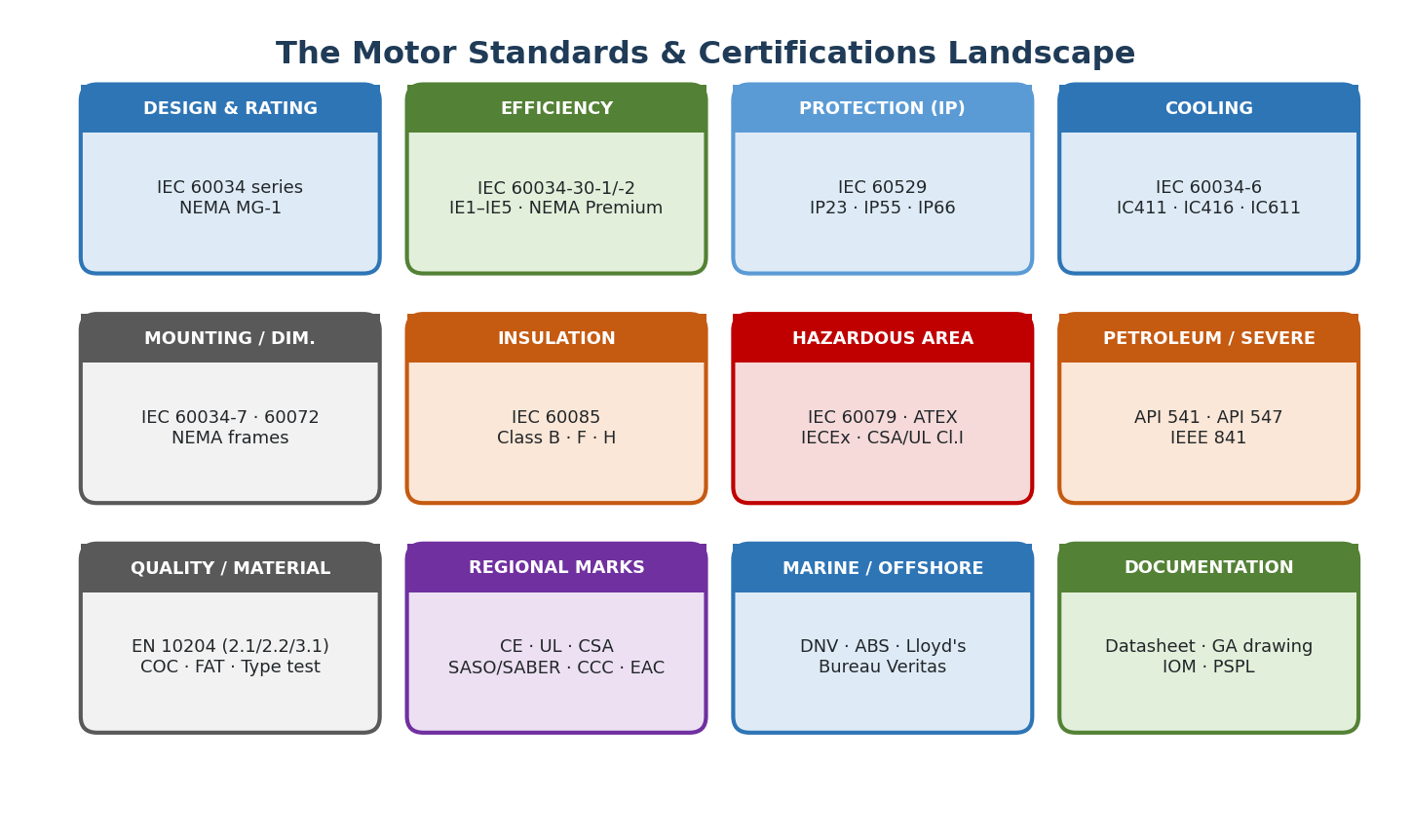
Figure 8.1 — The standards and certifications landscape, grouped by what each one governs.
8.1 Standard vs certification — the key distinction
A standard tells the manufacturer how a motor should be designed, rated, or tested (for example IEC 60034, NEMA MG-1, API 541). A certification proves the motor complies with certain requirements (for example CE, UL, CSA, ATEX, IECEx, SASO). One is the rulebook; the other is the proof the rules were followed.
ANALOGY A standard is the building code; a certification is the inspector's signed certificate that this building meets it. The code defines the requirement; the certificate is the evidence. |
8.2 The IEC 60034 family — the core design standard
For day-to-day IEC work, the most important standard is IEC 60034, a multi-part family covering rating, performance, testing, cooling, mounting, and protection of rotating electrical machines. Whenever someone says “an IEC motor,” they mean a machine built to this family. The parts you will meet most:
Standard |
Governs |
IEC 60034-1 |
Rating and performance (ratings, duty types S1–S10, tolerances) |
IEC 60034-2-1 |
Methods for determining efficiency / losses |
IEC 60034-5 |
Degrees of protection by enclosure — the IP code (with IEC 60529) |
IEC 60034-6 |
Methods of cooling — the IC codes (IC411, IC416, IC611…) |
IEC 60034-7 |
Mounting arrangements — the IM codes (B3/IM1001, B5/IM3001…) |
IEC 60034-8 |
Terminal markings and direction of rotation |
IEC 60034-14 |
Mechanical vibration limits |
IEC 60034-30-1 / -30-2 |
Efficiency classes (IE code) for line and variable-speed motors |
IEC 60072 |
Frame numbers, dimensions, and output assignments |
IEC 60085 |
Thermal classification of insulation (Class B / F / H) |
IEC 60529 |
Degrees of protection (IP code) — referenced detail |
8.3 NEMA — the North American design standard
North American motors generally follow NEMA MG-1. It differs from IEC in several visible ways: power in HP rather than kW, NEMA frame designations, the use of a service factor, and the NEMA design letters A, B, C, and D that define torque/current characteristics.
WATCH OUT If a customer asks for a NEMA motor, do not offer an IEC motor without checking interchangeability — frames, mounting, and torque classes are defined differently, and they rarely line up exactly. |
8.4 Efficiency classes — IE code and minimum-efficiency laws
Efficiency is graded by the IE (International Efficiency) code in IEC 60034-30-1 (line-fed motors) and IEC 60034-30-2 (variable-speed motors). North America uses comparable NEMA Premium levels. Crucially, efficiency is increasingly a legal requirement, not just a preference.
Class |
Level |
Status |
IE1 |
Standard efficiency |
Largely phased out for many ratings |
IE2 |
High efficiency |
Minimum in many regions, now superseded for larger sizes |
IE3 |
Premium efficiency |
Common mandatory baseline |
IE4 |
Super-premium efficiency |
Mandatory for some ranges (see below) |
IE5 |
Ultra-premium efficiency |
Newest class, introduced for variable-speed motors and the latest edition |
STANDARDS REFERENCE Regulatory example: under EU Ecodesign Regulation (EU) 2019/1781 (in force from 1 July 2021), 0.75–1000 kW motors generally require IE3, and from 1 July 2023 motors from 75 kW to 200 kW must reach IE4. Always check the destination market's current minimum-efficiency rules before quoting — they change, and compliance is mandatory. |
8.5 Hazardous-area certification
If an RFQ mentions Zone 1, Zone 2, or Class I Division 2, you are in hazardous-area territory — places where flammable gas or dust may be present. A standard TEFC motor is never acceptable here. The relevant frameworks:
Scheme |
Region / use |
Notes |
IEC 60079 series |
International design standard for Ex equipment |
Defines protection types (Ex d flameproof, Ex e increased safety, Ex n…) |
ATEX (2014/34/EU) |
European Union |
Mandatory CE-marked Ex certification for the EU |
IECEx |
International scheme |
Globally recognised Ex certification based on IEC 60079 |
CSA / UL Class I |
North America |
Division/Zone system for Canada and the USA |
Hazardous-area zones (gas): Zone 0 continuous presence, Zone 1 likely in normal operation, Zone 2 unlikely and short-lived. The North American Division system maps roughly: Division 1 ≈ Zones 0/1, Division 2 ≈ Zone 2. Temperature classes (T1–T6) limit the motor's maximum surface temperature.
WATCH OUT Never assume a logo on one motor photo proves a certificate. Ask the supplier for the actual Ex certificate covering the offered motor, the correct zone/gas group, and the temperature class — and confirm it matches the customer's area classification. |
8.6 Petroleum and severe-duty standards
Oil & gas and petrochemical customers may invoke API and IEEE standards that add design and documentation requirements well beyond a general-purpose motor:
API 541 — form-wound squirrel-cage induction motors (custom-engineered, roughly 250 HP / 375 kW and larger) for demanding petroleum service.
API 547 — general-purpose form-wound induction motors approximately 250–3000 HP (185–2240 kW); simpler than API 541, modelled in part on IEEE 841.
IEEE 841 — severe-duty TEFC motors for the petroleum and chemical industries, emphasising reliability and long life.
API 546 — synchronous machines, where applicable to large compressor and pump drives.
8.7 Regional conformity marks
Mark |
Meaning / region |
CE |
Manufacturer's declaration of conformity with applicable EU regulations — a conformity marking, NOT an efficiency or quality rating |
UL |
Common certification in the USA / North America; often required by plants, OEMs, and commercial buildings |
CSA |
Canadian certification — frequently required instead of UL on North American projects, including hazardous-area motors |
SASO / SABER |
Saudi conformity and product-registration scheme; often excluded from quotations unless specifically requested |
CCC |
China Compulsory Certification |
EAC |
Eurasian Conformity (Russia / EAEU customs union) |
SALES TIP Because SASO/SABER carries cost and time, many suppliers write “SASO/SABER not included” by default. If the destination is Saudi Arabia, raise it early and price it in — don't let it surface after the PO. |
8.8 Testing — routine, type, FAT, SAT
Routine tests are performed on every motor and typically cover insulation resistance, winding resistance, no-load current, a high-voltage (hi-pot) test, and rotation check; the customer normally receives a routine test report. Type tests are run only on representative units and add temperature-rise, efficiency verification, noise, vibration, and locked-rotor performance. A FAT (Factory Acceptance Test) is witnessed (or unwitnessed) testing before shipment — note that “unwitnessed routine FAT included” means the routine tests are done but the customer is not present. A SAT (Site Acceptance Test) is performed after installation, more common on large projects than on standard LV motors.
8.9 The documentation package
Document |
What it is / why it matters |
Datasheet |
The primary technical approval document — electrical, mechanical, environmental, performance data |
GA drawing |
General Arrangement: dimensions, shaft, foot holes, flange, terminal-box location, weight |
Routine test report |
Results of the per-unit factory tests |
Certificate of Conformity (COC) |
Confirms the supplied motor matches the PO, specification, and standards |
IOM manual |
Installation, Operation & Maintenance: lubrication, bearings, storage, commissioning, troubleshooting |
Material certificate (EN 10204) |
Material traceability; 2.1 / 2.2 declarations vs 3.1 with independent inspection results |
Hazardous-area certificate |
Ex compliance evidence for the offered motor and zone |
Packing list / Commercial invoice |
Weights, dimensions, package count; price, HS code, origin, Incoterms |
Certificate of Origin |
Country of manufacture — for customs and trade agreements |
Material certificates follow EN 10204: types 2.1 and 2.2 are manufacturer declarations, while 3.1 provides independent inspection results and is commonly required for critical projects.
WORKED EXAMPLE A refinery project might request: datasheet, GA drawing, routine test report, COC, IOM manual, packing list, commercial invoice, certificate of origin, hazardous-area certificate, material certificate, and FAT report. Recognising the whole package lets you request it from the supplier in one clean email. |
8.10 The professional supplier request
Instead of “please send documents,” write: “Kindly provide the following for technical evaluation: datasheet; General Arrangement (GA) drawing; routine test report; Certificate of Conformity (COC); IOM manual; applicable hazardous-area certificates (if any); efficiency declaration; and recommended spare-parts list (PSPL).” The specificity gets you a complete answer the first time.
Knowledge Check — Chapter 8
What is the difference between a standard and a certification?
Which IEC 60034 part defines duty types? Which defines cooling (IC) codes?
When would you expect an ATEX or IECEx certificate, and what does Zone 2 mean?
What does the IE code measure, and why can it be a legal requirement?
What is the difference between a routine test and a type test?
A refinery requests datasheet, GA drawing, FAT, routine test report, and COC — briefly state the purpose of each.